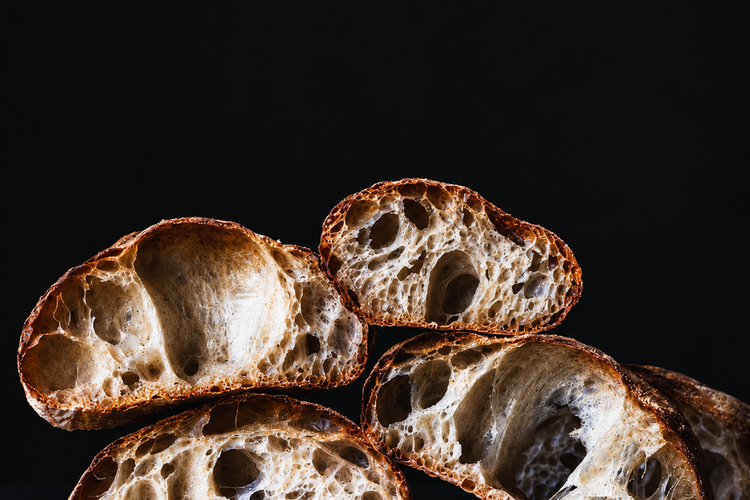
Pan de Cristal, or “glass bread”, is one of Spain’s most famous modern breads. It was created in Barcelona in the early 2000s. The crust is thin, crackly and almost see-through, and inside the bread is so full of big, open holes that it feels nearly weightless. The secret is a very wet dough, with as much water as flour by weight. You don’t need special skills, just some patience and a stand mixer.
Prep: 45 min
Rise: about 4 hrs
Bake: 50 min
Makes: 4 small loaves
Ingredients
- 500 g (about 4 cups) strong bread flour, 13% protein or higher
- 500 g (about 2 cups) lukewarm water, divided
- 1 tsp instant or active dry yeast
- 10 g (about 2 tsp) fine sea salt
- Olive oil, for the bowl
- Extra flour or semolina, for dusting
Instructions
- Start the dough. In a stand mixer bowl, combine the flour with 375 g of the water. Mix on low with the dough hook until no dry flour remains, then rest for 20 minutes. This makes the dough easier to knead.
- Add the yeast and salt. Stir the yeast into 50 g of the remaining water and add it to the bowl with the salt. Knead on medium for 5–6 minutes.
- Add the rest of the water slowly. With the mixer running on medium-high, pour in the last 75 g of water a little at a time, letting each splash absorb. Keep kneading for 10–15 minutes, until the dough is glossy, pulls away from the bowl, and stretches thin without tearing (the windowpane test).
- Stretch and fold. Move the dough to a well-oiled container. Over the next 1½ hours, do 3 sets of stretch-and-folds, 30 minutes apart: with wet hands, lift one side of the dough, fold it over itself, turn the container and repeat on all four sides.
- Bulk rise. Cover and let the dough rise for another 1–1½ hours, until it has more than doubled and is jiggly, domed and full of bubbles.
- Divide gently. Dust the counter generously with flour or semolina. Tip out the dough, dust the top, and use a bench scraper to cut it into 4 rectangles. Don’t shape it or knock out the air. Move the pieces onto two sheets of parchment.
- Final proof. Leave the loaves uncovered for 45–60 minutes. Meanwhile, put a baking stone or heavy upside-down tray on the lower rack and preheat the oven to 250°C (480°F) for at least 45 minutes.
- Bake. Slide one sheet of loaves onto the hot stone. Bake for 18–20 minutes, then flip the loaves and bake 5–8 minutes more, until deep golden all over. Repeat with the second batch.
- Cool. Let the loaves cool on a wire rack for at least 30 minutes before slicing, so the crumb can set.
Tips for Perfect Pan de Cristal
- Use high-protein flour. It needs to hold all that water.
- Wet your hands, not the counter, when handling the dough, so it doesn’t stick.
- Be patient with the kneading. The dough will look like batter at first, then suddenly come together.
- Handle it as little as possible after the rise, so the air bubbles stay in.
- Bake until deeply browned. A pale crust goes soft as it cools.
How to Serve It
Slice the loaves horizontally and toast them. For pan con tomate, rub the warm toast with a cut garlic clove, then a ripe tomato half. Drizzle with olive oil and sprinkle with flaky salt. It’s also great with jamón, Manchego cheese or anchovies.
Storage
Pan de cristal is best eaten the day it’s baked. Store leftovers in a paper bag for up to 1 day, or freeze them, well wrapped, for up to 1 month. Re-crisp in a hot oven for 5 minutes.
FAQ
Can I knead it by hand?
It’s possible with slap-and-fold kneading, but a dough this wet is much easier in a stand mixer.
Why is my bread dense?
The dough was probably under-kneaded or under-proofed, or it was pressed too much when you divided it.
Can I use all-purpose flour?
Use 50 g less water, because all-purpose flour can’t absorb as much.